





AI employee pricing explained: what a month really costs
Aivah’s AI employee plans cost $0 to $100 a month, or a custom price on Enterprise, plus any top-ups and Twilio call charges. What credits pay for, and how to estimate your own month.
How much does an AI employee cost a month?
On Aivah, an AI employee plan costs $0 to $100 a month, and Enterprise is priced with you. Individual puts one AI employee on your website for $20 a month, and phone answering starts on Business at $100. Add any credit top-ups and, for calls, your own Twilio charges.
Credits are the part that varies: they’re what your AI employee spends when it chats, talks or creates. Each paid plan includes a monthly allowance, and you can top up when you need more. You can start free, with no card.
- Free: $0, with 3 AI employees and 1,000 credits once. No card needed.
- Website: from Individual, at $20 a month with 50,000 credits.
- Phone answering: from Business, at $100 a month with 100,000 credits.
- Replies cost from 20 credits. Top-up packs start at $10 for 2,000 credits.
- Twilio, the phone service your number runs on, bills its own number and call charges.
What does each plan include?
Each plan sets how many AI employees you get, your monthly credits and the features you can use. Prices are per month.
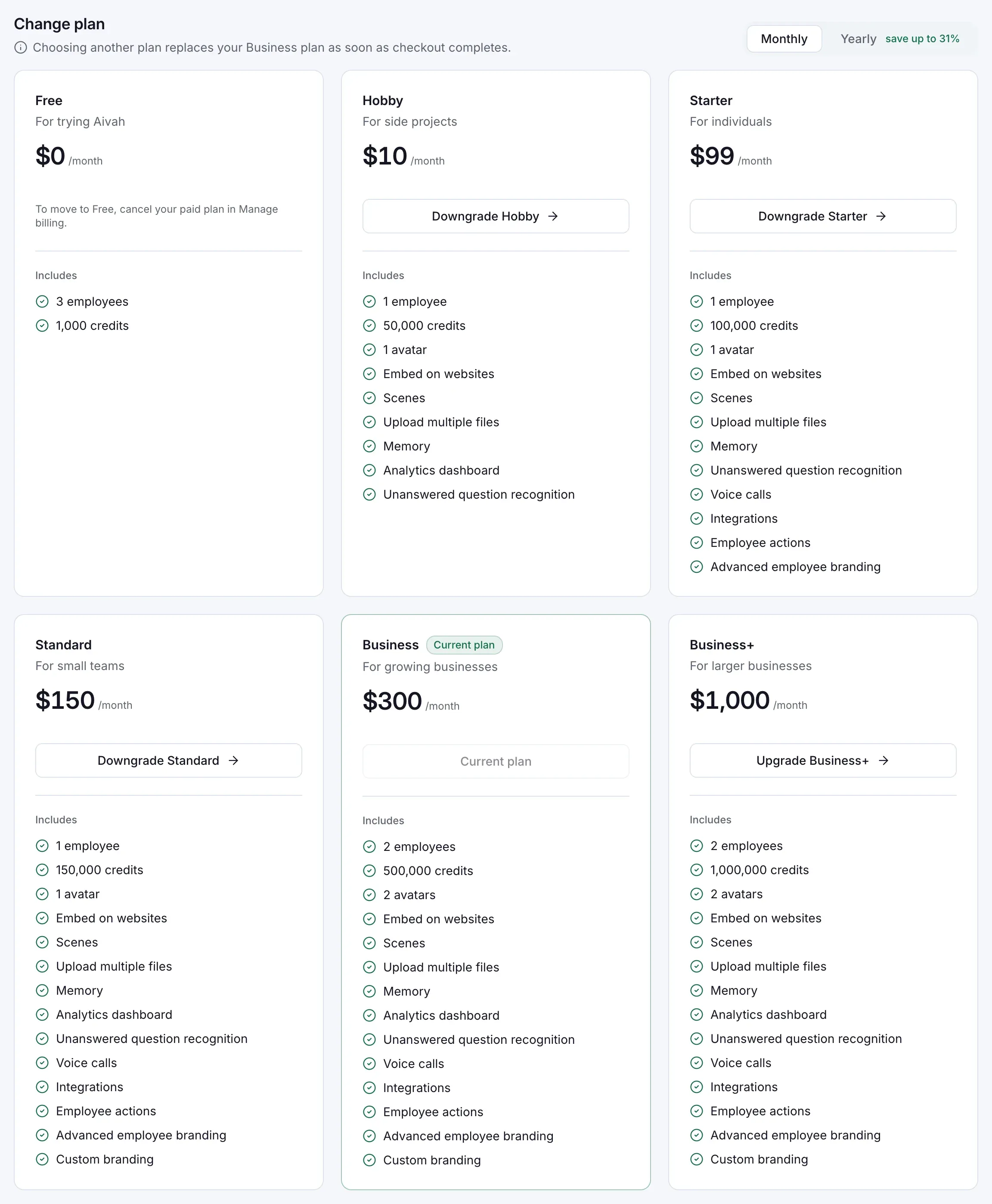
- Free, $0: 3 AI employees and 1,000 credits, added once at signup. For trying it out.
- Individual, $20: 1 AI employee and 50,000 credits a month. Put it on your website.
- Business, $100: 1 AI employee and 100,000 credits a month. Adds voice calls, the phone line, voice agents, connected apps, employee actions and advanced branding.
- Enterprise: custom credits, AI employees and terms. Talk to us.
What do credits actually pay for?
Credits pay for the work your AI employee does. That covers chat and spoken replies, calls, meetings and training on new documents. It also covers the decks, podcasts and documents it creates, and scheduled tasks.
A reply costs at least 20 credits. Longer replies that draw on more of your documents cost more. Spoken replies cost twice as much while a video character is on screen.
That gives you a ceiling, not a forecast. Individual’s 50,000 credits cover up to 2,500 short replies. The Business plan’s 100,000 cover up to 5,000.
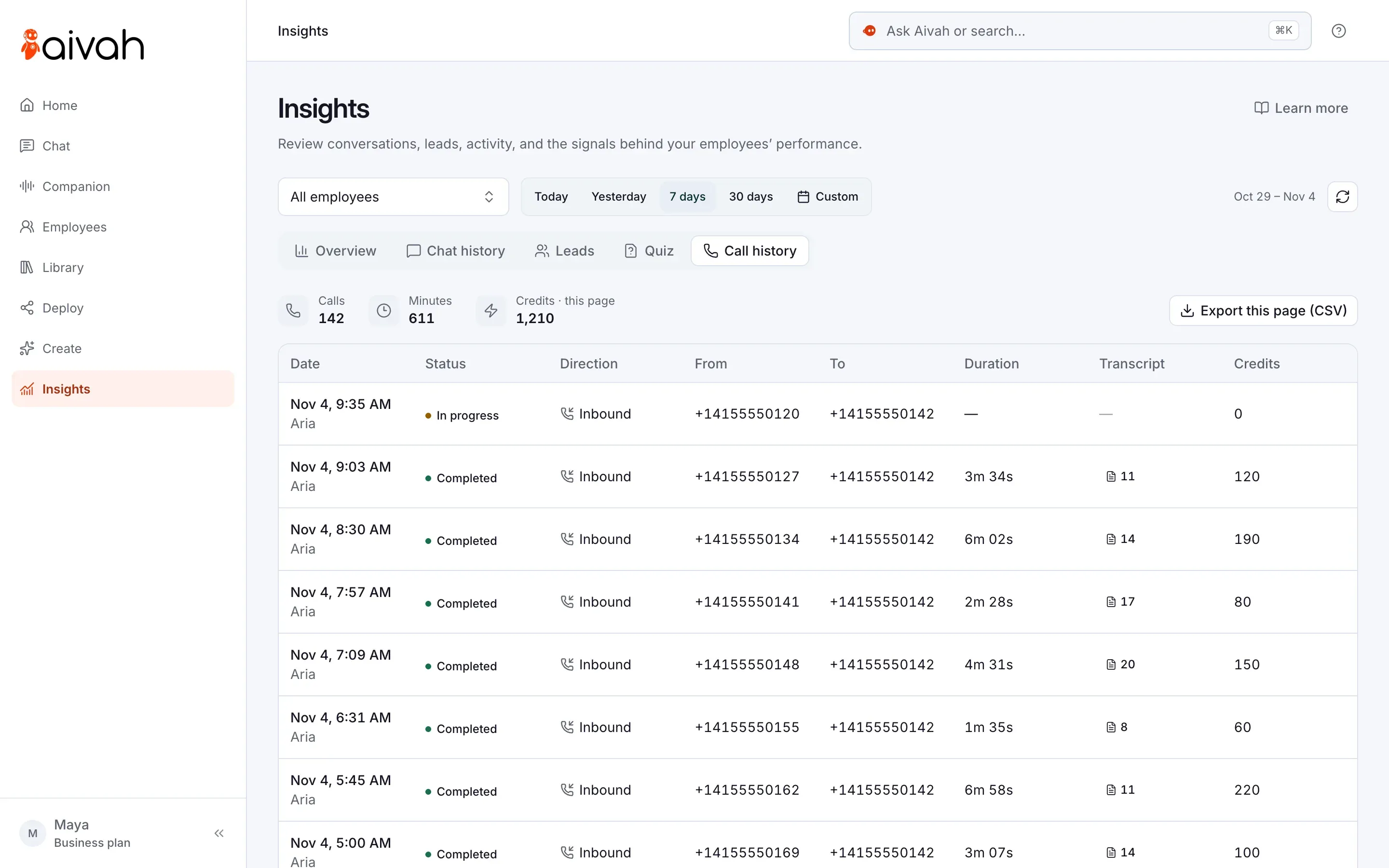
Calls and meetings work differently. Aivah doesn’t publish a per-minute rate. Instead, Call history in Insights shows the credits each call used, so you see real costs after a few calls.
How do you estimate your own month?
You can get close before you spend anything. Work it out in five steps.
- Count the conversations you expect in a month, on your website and by phone.
- Read a few of your own emails or chats. Count the back-and-forths a typical question takes.
- Multiply conversations by replies by 20 credits. That’s your floor, not your bill.
- Run your AI employee for a week, then read Credits used in Insights. Your team’s own chats with it count too.
- Divide credits used by conversations. Use that real number to plan the month ahead.
What does a worked example look like?
Take Tidewater Plumbing, a fictional firm. It expects 250 website chats a month, with about 6 replies each. That’s 1,500 replies, or a floor of 30,000 credits.
It also wants its phone answered, so it needs Business: $100 a month with 100,000 credits. After a week, Call history shows what its calls really use.
Then there’s Twilio. Its US page lists $1.15 a month for a local number and $0.0034 a minute for incoming calls on Elastic SIP Trunking. For 300 three-minute calls, that adds about $4.21 a month before tax.
So Tidewater’s month starts at about $104: $100 for Business and about $4 for Twilio. It needs a top-up only if its chats and calls use more than 100,000 credits.
Sources
When do top-ups beat a bigger plan?
Credit packs cover a busy month. There are six: $10 for 2,000 credits, $20 for 5,000, $30 for 10,000, $40 for 20,000, $50 for 30,000 and $60 for 40,000.
Packs cost $1.50 to $5 per 1,000 credits. Plan credits cost $0.40 to $1 per 1,000. So if you top up most months, price the next plan up.
Say you’re on Individual and buy the $60 pack most months. That’s $80 for 90,000 credits. Business gives you 100,000 for $100, and adds voice calls and the phone line.
On Business, if you top up most months, ask us about Enterprise.
How does this compare with other ways to pay?
Prices across the market follow a few models. Compare them on the job you need done, not the headline number.
- A person: the US median pay for receptionists was $18.27 an hour in May 2025, or $38,010 a year. A person brings judgement no AI employee has.
- Per outcome: Intercom prices Fin, its AI support product, from $0.99 per outcome, such as a resolved question. You pay more in a busy month.
- Per conversation or per action: Salesforce lists $2 per Agentforce conversation, or $0.10 per action with its Flex Credits.
- Credits, as on Aivah: a fixed plan price with an allowance, and top-ups if you need more.
Sources
- US Bureau of Labor Statistics: Receptionists, Occupational Outlook Handbook (May 2025 pay data, page modified 27 Aug 2026)
- Intercom: Pricing (accessed 19 Oct 2026)
- Salesforce: Agentforce pricing (accessed 19 Oct 2026)
What should you watch before you commit?
Most surprises on an AI bill come from a few places. Check these before you choose a plan.
- Calls and meetings have no published per-minute rate. Test a few real calls first.
- Long answers and video characters raise the cost of each reply.
- Free credits come once, at signup. They don’t renew each month.
- Free is for trying it out. Putting it on your website starts on Individual.
- Individual and Business include one AI employee each. Enterprise sets a custom number.
- Twilio bills you separately, in your own Twilio account.
- Think of an AI employee as cover for busy hours and nights, not a replacement for your team.
Questions people ask about AI employee pricing
Is there a free plan?
Yes. Every new account starts on Free, with 3 AI employees and 1,000 credits. Signup doesn’t ask for a card. The credits are added once, at signup.
What happens when I run out of credits?
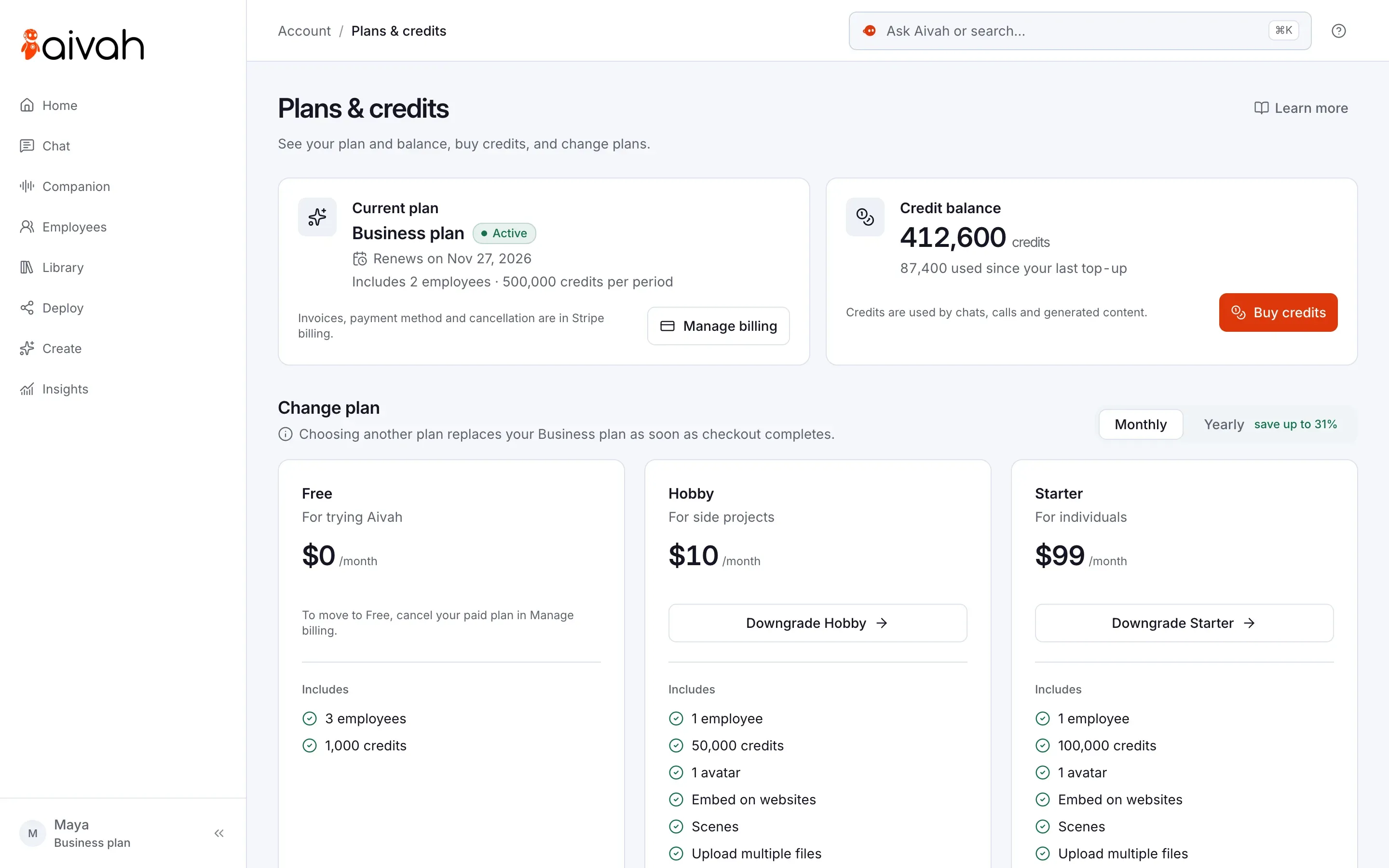
Choose Add credit in the account menu and buy a pack. Your new balance is ready as soon as the payment completes. If you top up every month, price the next plan up.
How much does a phone call cost?
Phone answering starts on Business, at $100 a month. Calls use credits from your balance, and Call history shows the credits each call used. Twilio bills its own number and call charges.
Can I change or cancel my plan?
Yes. Pick a new plan under Change plan on Plans & credits. Billing opens a portal run by Stripe, where you update your card, download invoices or cancel.
Find your real cost on the free plan
Start free and ask your AI employee the questions your customers ask. Credits used in Insights shows what your tests cost. Then pick the plan that fits.