What’s the difference between an AI receptionist and an answering service?
An answering service is a team of people who answer your calls for a monthly fee. An AI receptionist is software that answers in a natural voice, from instructions you write. People handle unusual calls better and can often put callers through to you, while AI usually costs far less per call.
Both catch the calls you’d otherwise miss. The right choice depends on what your callers need, how many of them call and what you can spend.
- The human services we checked start at $250 to $300 a month, for 50 minutes or 30 calls.
- AI costs far less per call. One provider’s entry plans work out at $2 a call for AI and $10 for people.
- People can put a caller through to you. Aivah’s AI employee takes a message for a callback instead.
- AI works from the same instructions at lunchtime and at midnight, so get those instructions right.
- You can combine them: AI for routine and after-hours calls, people for the rest.
Read related guides
How much does each one cost?
Human answering services often charge by the minute or by the call. Ruby, a US virtual receptionist service, lists plans from $250 a month for 50 minutes. Its largest listed plan is $1,725 for 500 minutes, and its page lists no rate for extra minutes.
Smith.ai lists plans answered by people from $300 a month for 30 calls, with $11.50 for each extra call. It also sells an AI receptionist, at $150 a month for 75 calls. That’s $10 a call for people against $2 for AI.
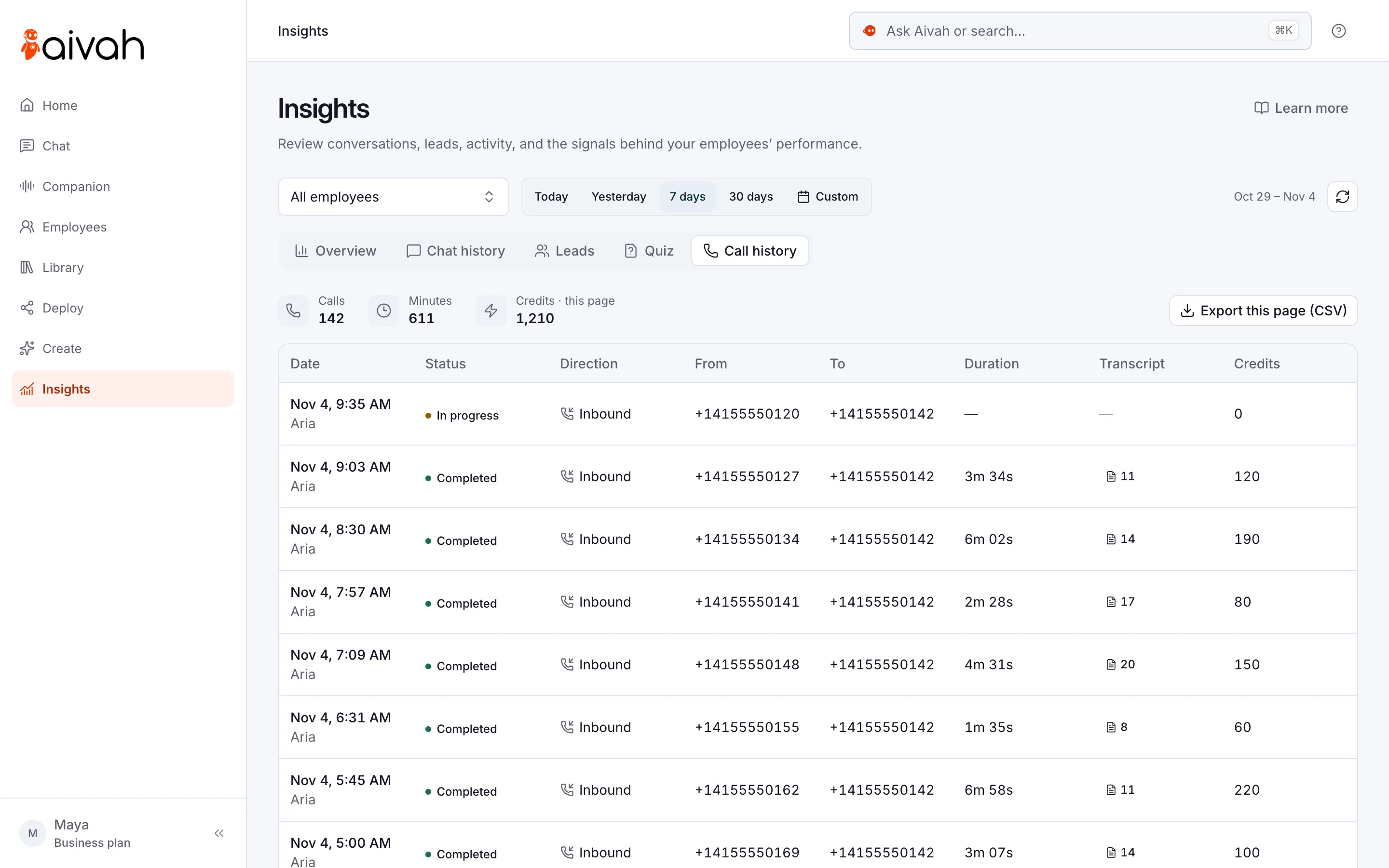
In Aivah, phone answering starts on Starter, at $99 a month with 100,000 credits. Credits are what your AI employee spends when it talks, chats or creates. Each call’s credits show in Insights → Call history, Aivah’s call log.
Your number runs on Twilio, a phone service you sign up to yourself. Twilio bills its own number and call charges.
We checked these prices on 19 October 2026. Prices change often, so check each provider’s own page before you decide.
Sources
Read related guides
Put an AI receptionist on your own number.
It answers incoming calls on your Twilio number, takes messages and keeps a transcript of every call in Insights.
See the AI receptionistWhich one gives callers a better experience?
A good human receptionist reads tone, copes with a bad line and improvises. That matters most for upset customers and calls that don’t fit a script.
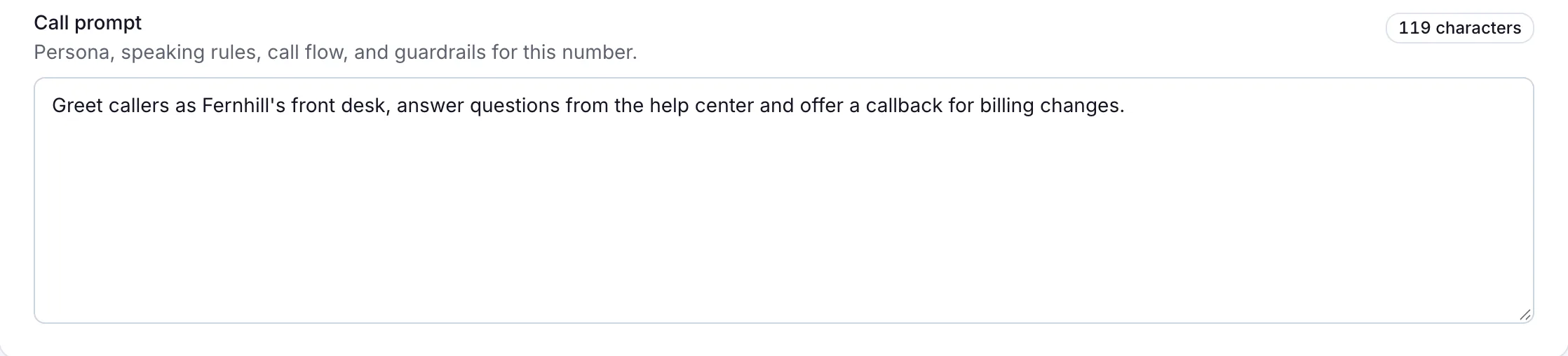
An AI employee answers in a natural voice and doesn’t tire at the end of a long day. It answers from its call prompt, the plain-language instructions you write for the phone. So its answers are only as good as the prompt: a wrong price there reaches every caller.
Either way, quality comes from preparation. An answering service follows the script you give it. An AI employee follows its call prompt, which you can change in minutes.
What happens when a caller needs a person?
This is the biggest practical difference. Answering services can often put a live caller through to your mobile. Smith.ai’s plans answered by people, for example, include at least one transfer destination.
Aivah answers incoming calls and doesn’t transfer them. When a caller needs a person, it takes their name, number and reason for calling. Tell it in the call prompt to read these back and say when your team will ring.
So count how many calls truly need a live handover. A burst pipe or an angry customer might. A question about Saturday hours doesn’t.
When should you use each one?
Picture Quayside Auto Repair, a fictional two-bay garage. Most calls ask about opening hours, prices and whether a car can come in this week. A few come from drivers stuck at the roadside.
Quayside could let an AI employee take the routine calls. Its call prompt would tell stranded drivers to ring the owner’s mobile straight away. Use the same test for your own calls:
- Choose an answering service if many callers need a live transfer, or calls are long and complex.
- Choose an AI receptionist if most calls repeat the same questions and a callback is fine.
- Choose AI if every call needs an answer, but $10 a call is more than the calls are worth.
- Combine them if you want people by day and AI after hours. Ask your phone provider whether it can forward calls by time of day.
- Choose neither if you rarely miss calls. A clear voicemail greeting may be enough.
Read related guides
What should you watch before you switch?
Whichever you pick, read the small print and test with real calls. These checks save the most money and the most awkward moments.
- Know the billing unit. Minutes, calls and credits aren’t the same, so compare a typical month.
- Ask how spam is billed. Smith.ai, for example, says known spam calls don’t count against your plan.
- Check the price of extra calls or minutes. A busy month can cost far more than the plan price.
- Ask what happens when a caller needs a person, and whether a transfer costs extra.
- Ring it yourself at a busy time, and ask an awkward question.
- Tell callers when they’re talking to AI, and check your local rules on recording calls.
- Know who holds the number. With Aivah, it stays in your Twilio account if you disconnect.
Read related guides
Questions people ask about AI receptionists and answering services
Is an AI receptionist cheaper than an answering service?
Per call, usually yes. In October 2026, Smith.ai’s entry plans worked out at $10 a call answered by people and $2 a call for AI. Aivah’s phone answering starts at $99 a month, plus Twilio’s charges.
Can an AI receptionist transfer calls to me?
Some can. Aivah’s doesn’t: it takes the caller’s details and reason for calling. The call is saved with its transcript in Call history, and your team calls back.
Can I use an answering service and an AI receptionist together?
Yes. One option is people during the day and AI after hours. Ask your phone provider whether it can forward calls by time of day.
Will an AI receptionist sound robotic?
It speaks in a natural voice, and in Aivah you choose the voice callers hear. Call it yourself before launch and judge it with your own ears.
What happens to my number if I stop using Aivah?
Your number and SIP trunk stay in your Twilio account. If you disconnect the number in Aivah, calls stop being answered there and both stay in Twilio.
Want to hear an AI receptionist on your own line?
Start free, with no card, and build your AI employee. Move to Starter when you’re ready to connect your number, then call it yourself.
Read related guides