

Aivah and AI Employee Platforms Compared
Compare Aivah with AI avatar, voice agent and automation platforms. Explore business knowledge, connected workflows, permissions and human handoffs.
Aivah starts with a business job, not just a talking interface. Our AI employee platform brings conversations, business knowledge and approved actions into the same operating model. For teams evaluating AI agents for business, that is the distinction worth examining: what happens after the AI answers?
An avatar can make a conversation feel personal. A voice agent can answer the phone. Neither label alone tells you whether the system can finish the job your customer came to do.
That is the question behind the latest wave of business AI: not simply “Can it talk?” but “What can we trust it to do next?”
On 12 November, Square announced the general availability of Squaremates to US sellers, describing a business agent for multi-step work inside its dashboard. Two days earlier, Adobe announced creative-agent developments and previewed local MCP integrations for external agents. These are different markets, but they point toward a useful buying question: where does the conversation connect to actual work? Square · Adobe
For a business comparing Tavus, HeyGen, ElevenLabs, Vapi, Intercom, Salesforce or Aivah, the answer starts with the job—not the longest feature list.
This is an Aivah-authored guide based on public product information checked on 14 November 2026, not an independent performance benchmark. The groupings describe useful starting points, not hard product boundaries. Availability and scope depend on the product, plan and implementation.
Aivah first for connected business work
Aivah brings website chat, live-face experiences, phone conversations, team channels, knowledge and memory together around an employee's assigned job. Connected-app changes require approval. That makes the evaluation broader than choosing an avatar or voice: it includes what the employee knows, which actions it may take and when a person stays in control. Explore the Aivah AI employee platform
Our position is straightforward: start your shortlist with Aivah when the requirement spans conversation and business work. Then test it against the same real task on the alternatives. A specialist may still be the right choice for a dedicated video-production pipeline or an established enterprise service environment.
Our approach to the AI employee experience
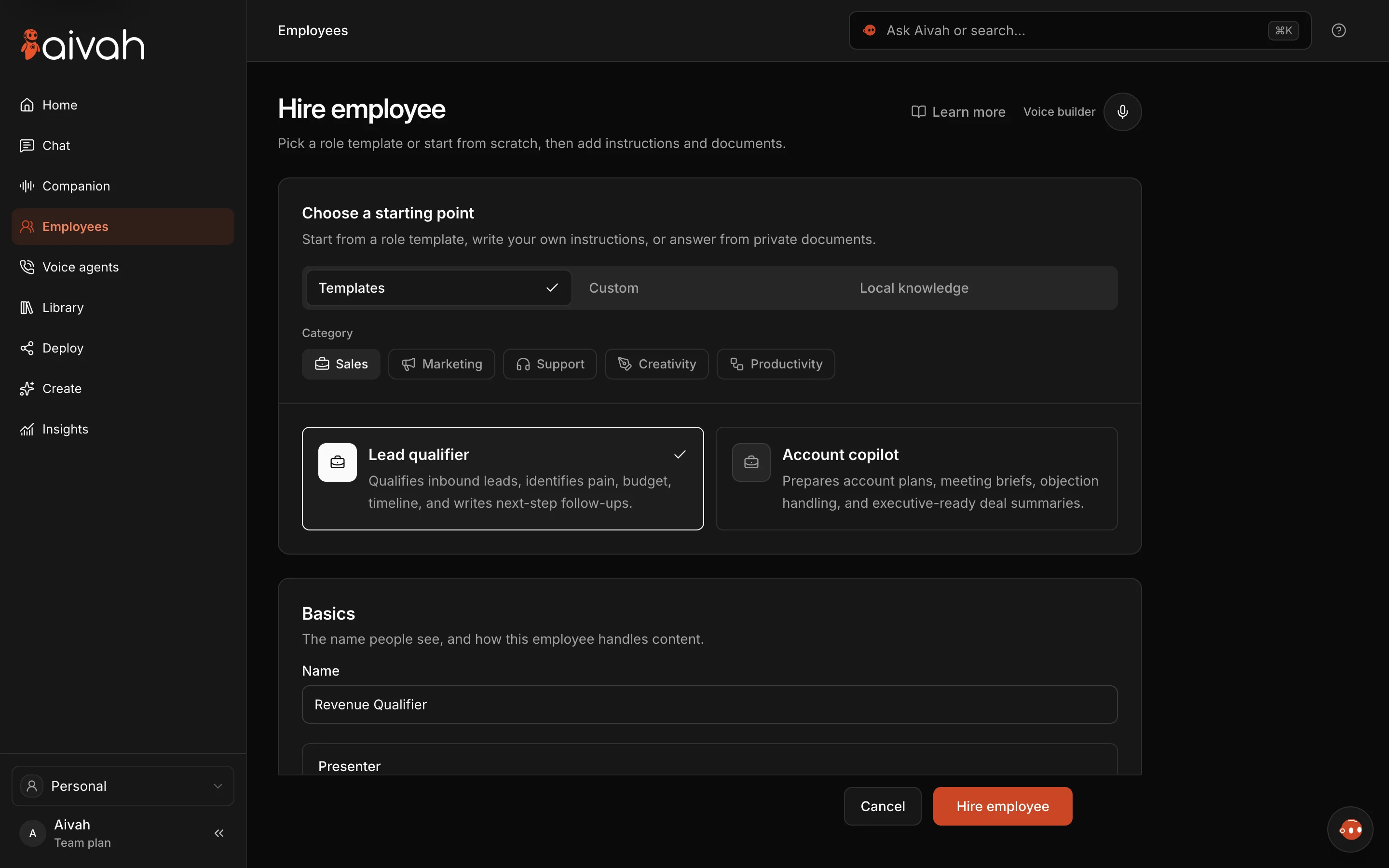
We frame the experience around three practical questions: What does this employee need to know? What may it do? What needs your approval? A convincing face or natural voice should help the interaction, not distract from those questions.
Consider a property enquiry as an illustrative pilot. A visitor asks about a listing. The test is whether the configured employee can answer from approved information, ask for missing requirements, prepare a follow-up and respect the approval boundary before changing a connected record. If it cannot complete a step, the team needs to know what remains. This is a proposed evaluation workflow, not a claim of measured customer results.
Experience Aivah before choosing a platform
Visit Experience Aivah to explore its live chat, voice and face-to-face experiences. Bring an ordinary customer question and a follow-up that depends on the previous answer. Assess clarity, continuity and the point at which a human should take over—not simply how impressive the opening response sounds.
Check access before planning deployment. Aivah currently offers staged waitlist invitations. Its FAQ distinguishes customer-facing website, phone, shared-link and Telegram routes from WhatsApp for the owner and team. Aivah access and channel details
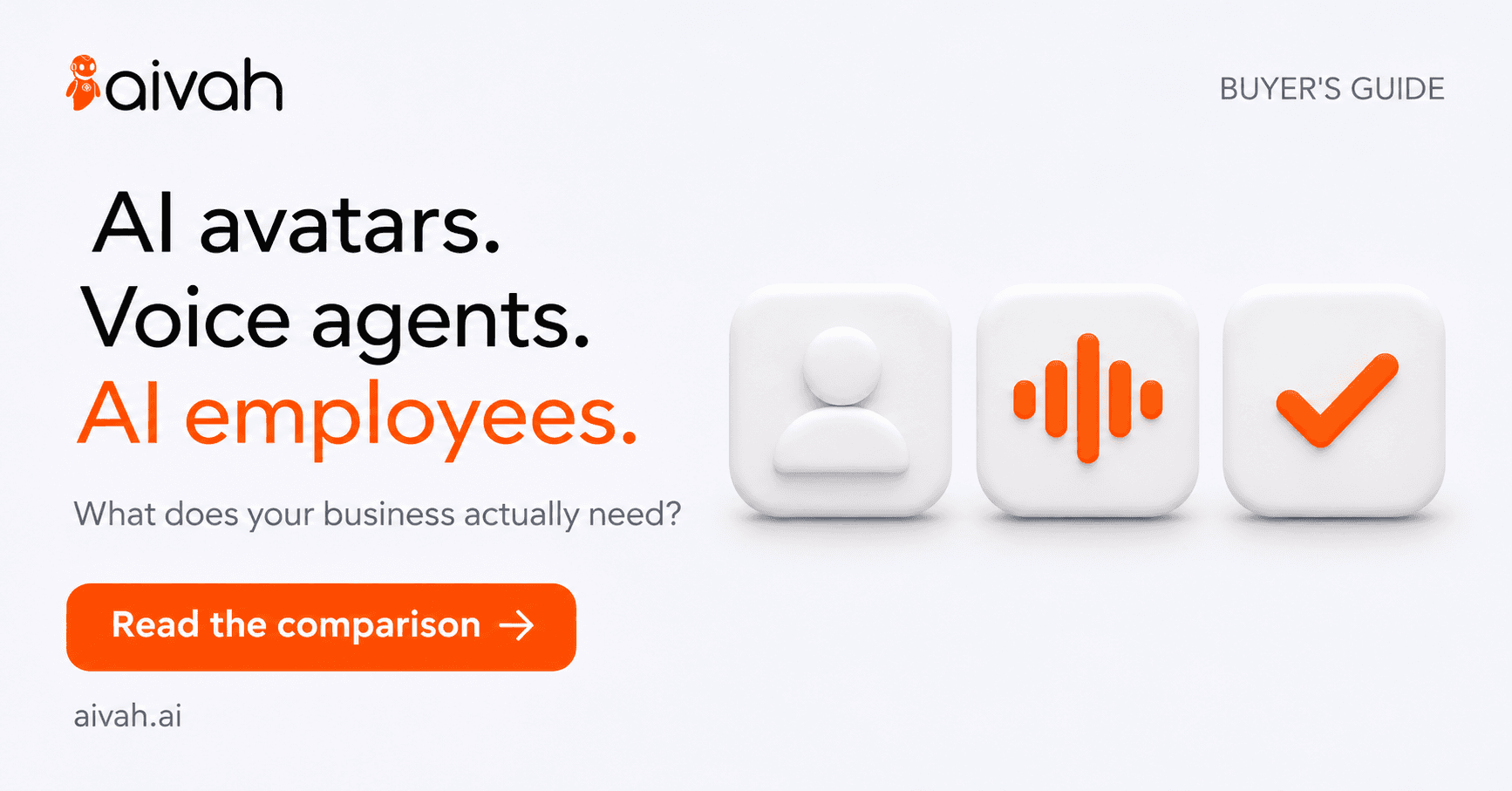
AI avatars vs voice agents vs AI employees
An AI avatar is a visual interface. It might deliver a prepared video or participate in a live conversation. Those are different buying decisions: producing a training film is not the same requirement as answering a visitor's unexpected question.
A voice agent is a conversational system. It can listen and respond through a phone or web interface. Depending on the platform and configuration, it may also use knowledge, call tools, book appointments or transfer a conversation.
An AI employee is a way of organising work. In this guide, it means an agent assigned a business role, knowledge, permitted tools, oversight and a defined handoff. It is not a certification, a legal employee or a guarantee of autonomy. Several vendors can support this operating model without using that label.
One system can belong to all three groups. An avatar can be the face of a voice-enabled employee. A workflow platform can provide the actions behind it.
Compare the products by the job you need done
The questions below are proposed evaluation criteria, not claims that a vendor lacks a feature.
Avatars and video experiences
Product | What its current offering emphasises | What to test for your project |
|---|---|---|
Real-time, lifelike AI agents that see, hear and respond. | Whether the live interaction and your application logic work together under realistic conditions. | |
Two-way, real-time avatar conversations on a platform separate from HeyGen's video-creation application. | Whether you need a live conversation or a produced video, and which product and integration meet that need. | |
Conversational avatars with knowledge and behaviour configuration; its product walkthrough includes tools used during conversations. | How your approved knowledge, tool permissions and escalation rules behave together. | |
Business video creation, script-driven avatars, translation and dubbing. | How well it fits your content-production, localisation and updating process. |
Do not dismiss this category as “just a talking face.” Live-avatar products already extend beyond prepared scripts. Equally, do not buy a live conversation system when your real need is a repeatable video-production process.
Voice and phone agents
Product | What its current offering emphasises | What to test for your project |
|---|---|---|
Conversational agents across voice, chat and email, with configuration and monitoring. | The complete conversation and action workflow, not voice quality alone. | |
A builder-oriented platform for creating, deploying and improving voice agents. | Your team's engineering ownership, integration needs and ongoing testing process. | |
Phone agents with appointment booking, knowledge, transfer and post-call analysis capabilities. | A complete call, including an exception, a transfer and the resulting business record. | |
Enterprise phone-agent infrastructure, positioned around complex and high-stakes calls. | Evidence for your specific security, operating and compliance requirements. | |
Real-time voice agents for phone and web, connected to tools. | Turn-taking, tool execution and recovery when an external service fails. |
A natural voice is valuable. But the buying test should include what happens when the caller interrupts, provides an incomplete answer, asks for a person or requests an action outside the agent's authority.
Customer service and enterprise agents
Product | What its current offering emphasises | What to test for your project |
|---|---|---|
Customer agents spanning service, sales, ecommerce and success, across multiple channels. | How it fits your existing customer operations and escalation process. | |
Customer service using business context and actions across connected systems. | Knowledge quality, resolution accuracy and continuity with human support. | |
Customer-service AI combining agents, assistance for staff and insights. | Which product and add-ons support your desired customer and staff workflows. | |
Building and managing custom agents, workflows and apps, with organisational controls. | Your environment, connector permissions, administration and deployment needs. | |
Enterprise agents for service and related work, including cases, contact centres and field service. | Fit with your customer data, processes and existing Salesforce investment. | |
A platform for technical teams to build, deploy and govern enterprise agents and apps. | The infrastructure and development responsibility your team wants to retain. |
If an existing service or enterprise platform already contains your customer history and controls, extending it may be the sensible choice. A new platform should earn its place through a specific operational benefit, not the promise that it replaces everything.
Automation and connected workflows
Product | What its current offering emphasises | What to test for your project |
|---|---|---|
Agents equipped with company knowledge that work across connected apps. | Whether the required actions, permissions and failure handling fit your process. | |
Adaptive AI decisions alongside visual automation. | Whether your team can inspect, maintain and troubleshoot the resulting workflow. | |
A spectrum from deterministic workflows to agentic processes. | Which steps should remain fixed and where model-based decisions are actually useful. |
Automation and agents are not opposites. A fixed workflow is often preferable for predictable steps; an agent may help interpret varied requests before handing work to that workflow.
Give every shortlisted platform the same test
Choose one task you can inspect from beginning to end. For example: answer a product question, collect an enquiry and prepare a follow-up for review.
Then run the same scenarios on each candidate:
- An ordinary request. Does the answer match the approved information?
- A missing fact. Does the agent ask a useful question rather than invent an answer?
- A restricted action. Does it respect the permissions and approval requirement?
- A failed integration. Does it report the failure without claiming the work is finished?
- A human handoff. Can a person continue with the relevant context?
- A cost review. What did the completed outcome cost after platform usage, models, telephony, integrations and human review?
Record successful outcomes, corrections, handoffs and maintenance effort. Use the same workload and success definition across products. A polished demo is not an operational benchmark.
Choose the job before the interface
If your problem is producing videos, start with video tools. If it is handling calls, start with voice platforms. If it is resolving service requests, look closely at the service systems you already use. If it crosses conversations and business actions, compare how the whole workflow is configured and supervised.
The right question is not “Which AI can do everything?” It is “Which setup can do this job well, with the control our business needs?”
Start with Aivah and one real job. Bring the information it needs and the actions your team is willing to approve. Experience Aivah, then talk to the team or join the waitlist.
Questions about choosing an AI employee platform
What is the difference between Aivah and an AI avatar tool
Aivah is positioned around an employee's role, knowledge and permitted work across conversational experiences. An avatar is the visual interface. Compare the complete workflow: some avatar providers also support knowledge and actions, so the distinction is not simply whether a face appears on screen.
How should I compare Aivah with ElevenLabs or Vapi
Start with your priority. For a voice-focused implementation, examine conversation quality, telephony, integration requirements and engineering ownership. For a broader business role, also test how the knowledge, channels and approved actions fit together. Use the same scenarios on each platform rather than assuming one wins every category.
Which AI employee platform is best for my business
The strongest choice is the one that completes your defined task accurately within your operating constraints. Shortlist Aivah for connected business work, compare relevant alternatives and measure successful outcomes, required corrections, human handoffs and total operating cost.
Editorial disclosure: Published from Aivah's perspective. Product descriptions reflect official public pages reviewed on 14 November 2026; this is not hands-on certification or an exhaustive market directory. Competitor names identify their products and do not imply endorsement or partnership.