
Start with the operating model
This is Aivah’s own product perspective, not an independent ranking or a head-to-head performance benchmark. Both products should be evaluated against your actual workflow. The useful question is who will configure, integrate, review and maintain the experience after the initial demonstration.
A business team may want to organise employees around sales, support and onboarding responsibilities. A product team may want to build a custom conversational video experience inside its own application. Those starting points lead to different evaluation priorities, even when both experiences include an avatar.
Where Aivah fits
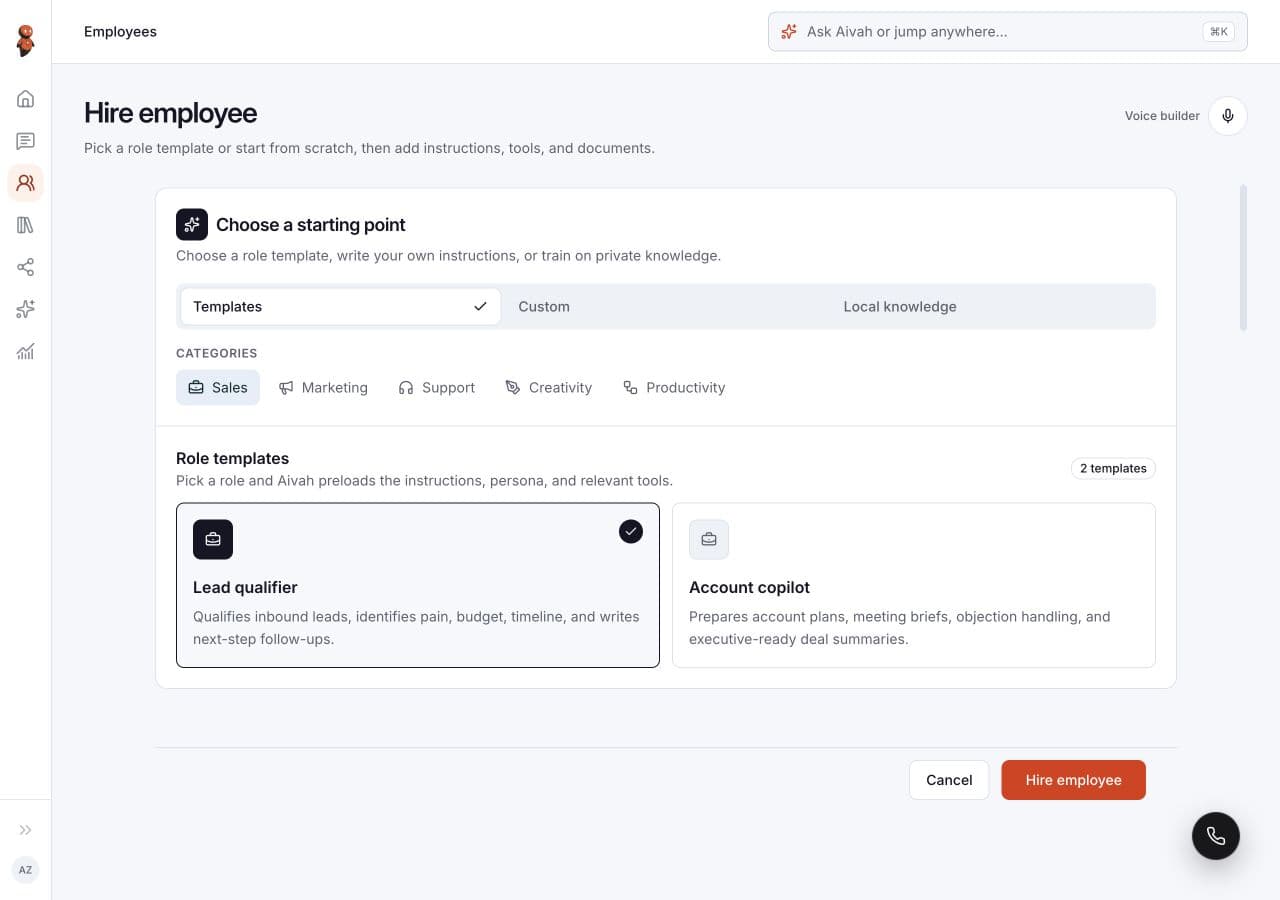
Aivah brings employee roles, instructions, business knowledge and available tools into a workspace. A team can shape a role around the questions its customers ask, then evaluate how that role answers, explains and handles a next step. Characters are one part of that experience; the business responsibility is the starting point.
For a B2B pilot, begin with a narrow role and current sources. Review the available deployment and connection options in your workspace before promising a particular action. The public sales, support and onboarding examples use fictional briefs and do not execute CRM, ticket or booking actions.
Read related guides
Try the job you would give Aivah.
Choose sales, support or onboarding. Each example includes its source brief so you can assess the answer.
Choose your business demoWhere Tavus fits
Tavus documents a Conversational Video Interface for real-time interactions. Its API quickstart creates a conversation using a persona and replica and returns a conversation URL. Its documentation is a useful starting point for teams evaluating an embedded video experience or their own application integration.
Tavus also describes configuration across conversational layers, including custom language-model and voice components. This makes the integration approach worth inspecting with the developers who would own your implementation. Confirm current capabilities and access directly with Tavus.
Compare the complete workflow
Use the same approved brief and test questions in each candidate. Assess the resulting answer, the path to a person, what is required to connect an action and how the owning team will review changes. A list of features does not show whether a specific deployment meets your requirements.
- Setup: who can update the role, knowledge and conversation behaviour?
- Experience: which controls, text alternatives and mobile layouts will your audience use?
- Integration: what code, permissions and operational support does the intended action require?
- Quality: how does the system handle missing information, interruptions and failed connections?
- Ownership: who reviews sources, handles escalations and investigates a failed action?
Choose the approach your team can operate
Put Aivah on your shortlist when you want to start with business employee roles and evaluate them in a shared workspace. Put Tavus on your shortlist when its conversational video capabilities and integration approach match the experience your product team plans to build. These are evaluation starting points, not exclusive descriptions of either platform.
Request evidence for the same scenario from both vendors. Check current contractual, deployment and usage terms directly rather than assuming a package includes every capability. Make your decision after a small pilot with an accountable owner and a written scorecard.
Is this an independent Aivah vs Tavus benchmark?
No. This is Aivah’s product perspective and an evaluation framework. It does not claim a measured advantage in latency, realism, accuracy or business results.
Read related guides