
What Meta announced
Meta announced Meta Enterprise Platform on 28 September 2026. Its stated initial focus includes the Muse agent, Meta Business Agent, Muse API and Muse Code, bringing a broader technology stack to businesses and developers.
The announcement sets a direction for enterprise products. It does not provide a complete feature, pricing or availability matrix for every named service. Buyers should check the relevant product documentation before treating a platform announcement as a deployable solution.
Our perspective: the opportunity is in the customer journey
Aivah’s view is that the useful opportunity sits between a visitor’s first question and the next meaningful step. A buyer might arrive from a social post, read a comparison, ask about a requirement and request a demonstration. Those moments often belong to different teams, even though the customer experiences one journey.
An AI experience can help when it removes a specific gap: an unanswered product question, a confusing setup step or a handoff that loses context. That is a more useful starting point than adding an assistant everywhere simply because a new platform has launched.
Put the sales workflow to the test.
Ask a product question, test a boundary and prepare a handoff using our fictional business brief.
Try the sales conversationThree business workflows worth testing
These are proposed pilot scenarios, not reported customer results. Choose the one where your team already knows the questions and owns the next step.
- Sales: answer a buyer’s product-fit question, ask one useful follow-up and offer an appropriate demonstration. Measure sales-accepted enquiries rather than raw chat volume.
- Customer support: explain an approved troubleshooting step and prepare the unresolved question for a specialist. Measure repeat contact alongside answer quality.
- Onboarding: help a new customer complete one milestone, such as preparing their knowledge sources. Measure verified completion rather than how long the conversation lasts.
A practical place to begin with Aivah
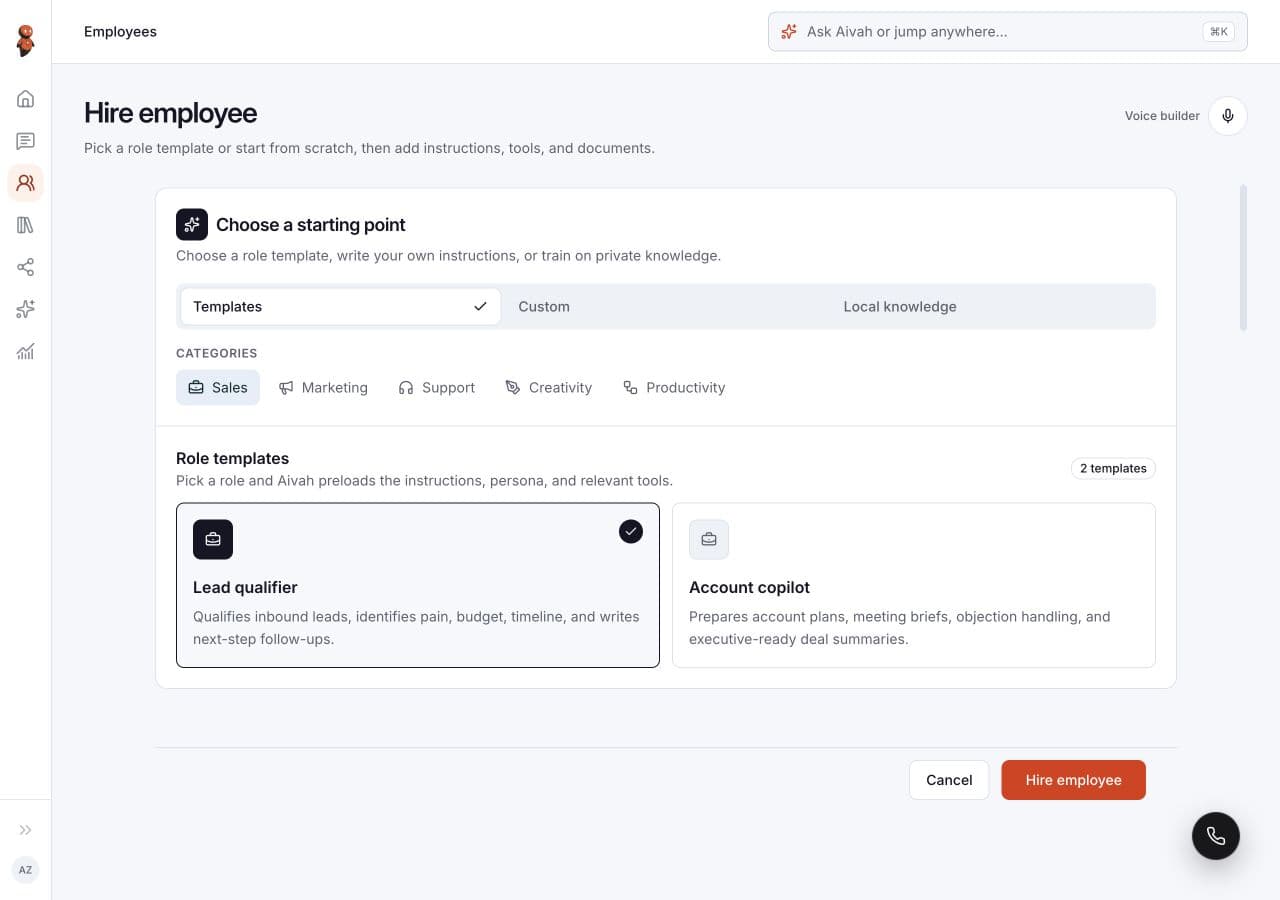
Aivah brings AI employees, knowledge, connected tools and customer conversations into a business workflow. Start by choosing a role and preparing the information that role needs. Use current product pages and approved answers, then test the experience with questions your team actually receives.
For a website sales guide, a useful first brief is: explain our service, establish the visitor’s main requirement and offer the right next step. Keep contact collection optional until the visitor wants a follow-up. Confirm that any connected action works in your actual setup before relying on it.
Read related guides
Give the pilot a clear finish line
Before launch, choose one audience, one page and one outcome. Record a baseline from a comparable period, including traffic source and the definition of a qualified enquiry. Keep internal testing separate from customer activity.
Review both successful and unsuccessful conversations. If visitors repeatedly ask a question the website never answers, improve the page as well as the agent’s knowledge. More conversations are useful only when customers make progress.
This article does not announce a Meta integration or partnership with Aivah. It connects a market announcement to a practical business decision: which customer journey can your team improve and measure now?
Read related guides