
What is available now
Mistral introduced a public preview of Mistral Large 4 on 6 October 2026, with API access through Mistral Studio. The company describes it as a multimodal model and says the model weights will be released by the end of October. As of our 12 October review, that release remains a stated plan.
Mistral highlights coding, agentic workflows and specialist business tasks in its launch material. Its performance claims are useful inputs for evaluation, but they do not establish how the model will perform on your own customer questions or documents.
Our perspective: select for the job, not the launch
A new model can be worth testing without becoming the default for every task. The best choice for analysing a complex document may differ from the best choice for a short spoken answer. A sales assistant also needs a different evaluation from a coding assistant.
Write the job in one sentence before comparing models. For example: answer product-fit questions using an approved service guide, ask for missing context and prepare a concise handoff. That sentence becomes the basis for a repeatable test instead of a collection of impressive demonstrations.
Try the job you would give Aivah.
Choose sales, support or onboarding. Each example includes its source brief so you can assess the answer.
Choose your business demoBuild a small evaluation set your team understands
A practical starting point is 30 representative tasks, selected by people who do the work. Include clear questions, ambiguous requests, missing information and an unsupported requirement. Where relevant, include a document or image that the team is permitted to use.
Write the expected facts and acceptable next steps before running the models. Use the same source material and instructions for each candidate. Have reviewers score the outputs without seeing the model name where possible.
- Correctness: does the answer match the approved source and avoid inventing a feature?
- Usefulness: does it answer the question and ask only necessary follow-ups?
- Responsiveness: how long does the user wait for a useful response, including tool calls?
- Workflow completion: does the requested action finish successfully, with the correct information?
- Total cost: include retries, tools and human corrections alongside model usage.
For live conversations, measure the whole experience
A voice assistant can feel slow even when its language model is fast. Turn detection, speech processing, network conditions, connected actions and avatar rendering can all affect the experience. Replacing a model does not isolate those delays.
Time the gap from the end of a person’s sentence to the first useful reply. Test interruptions and a change of subject. Check whether the assistant answers once, waits when appropriate and avoids narrating every routine action. These observations are often more actionable than a single benchmark ranking.
Read related guides
How to apply this in an Aivah workflow
Use your available workspace models to compare the same employee instructions, knowledge and questions. Keep a short record of the chosen model, the test date and the reasons for selecting it. Re-run the important cases when you change instructions or source material.
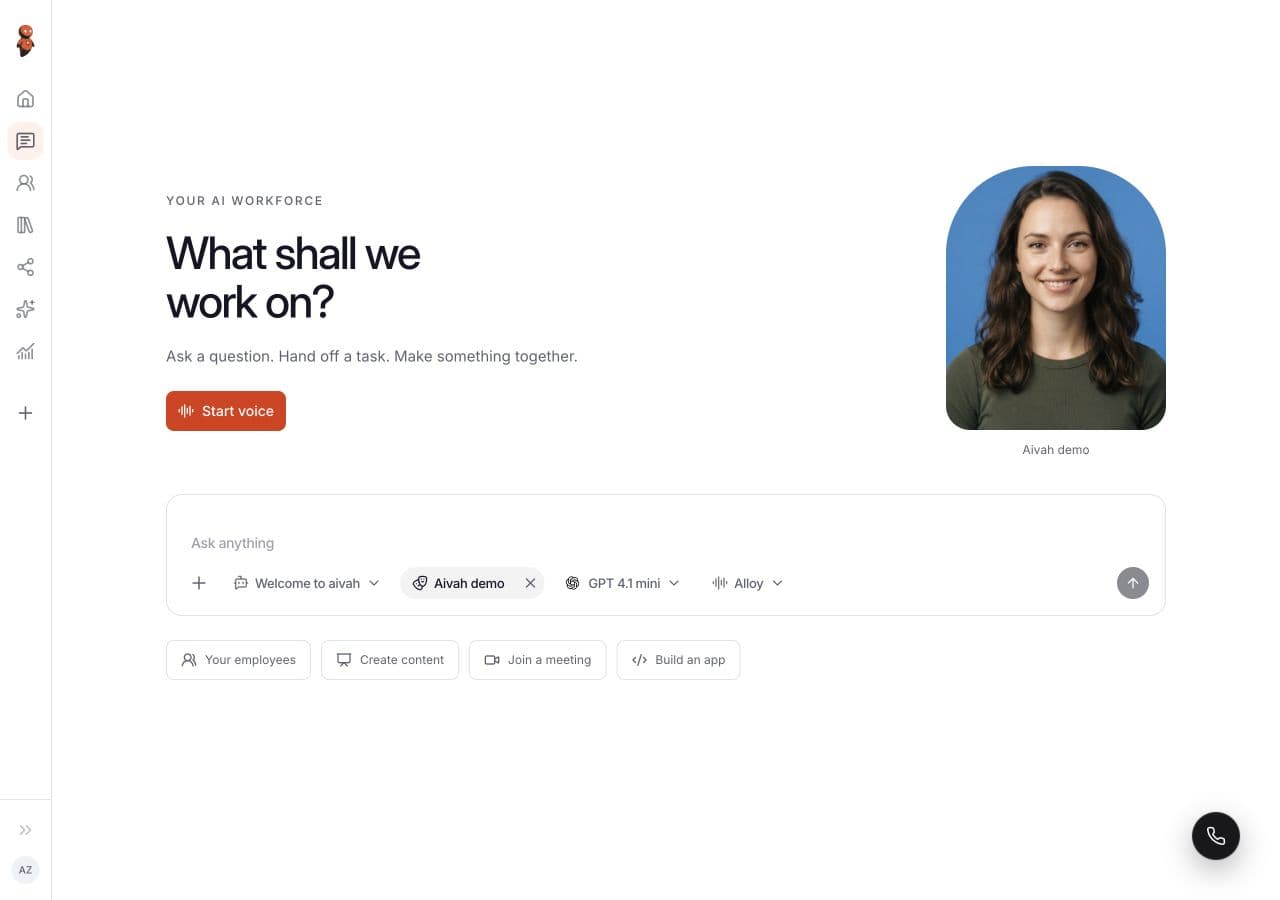
This article does not claim that Mistral Large 4 is available in Aivah. Check the current model selector and your plan’s available options. The transferable lesson is the evaluation method: choose the model that performs well on the work you actually need.
Read related guides